7 Common Soil Problems That Can Reduce Vegetable Yields
Published: 24 Aug 2026
You thought you did everything well. Good seeds, good spacing, and watered routinely too. And the harvest still came up short: stunted carrots, a tomato plant that barely grew, a bed that just didn’t look as full as expected. Weather, pests, and disease can all be the culprit, but soil is one of the factors gardeners often overlook, and it’s frequently part of the story even when something else is too.
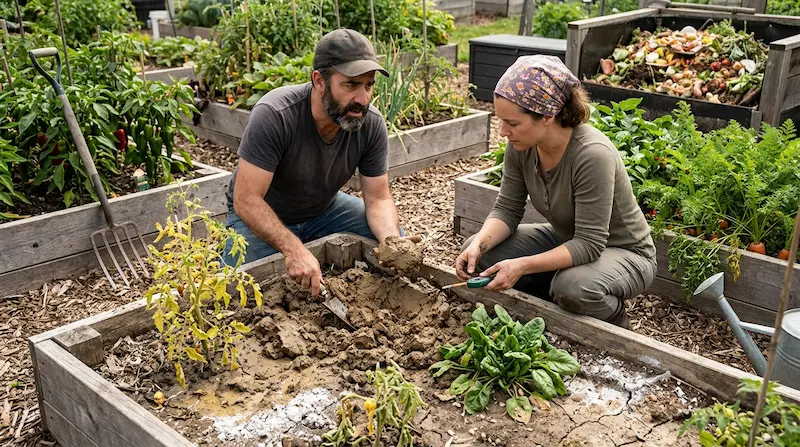
Here are seven problems that show up again and again in vegetable gardens and what’s actually happening underneath each one.
1. Compacted Soil Is Squeezing Your Roots
This is a major problem for plants. And it is very easy to overlook as the damage happens out of your sight. Compacted soil compresses the mineral particles so tightly together that the roots can’t spread properly.
Root vegetables show this the most clearly. If the carrots fork, twist, or become stubby and deformed, it can be a sign that they are being blocked by something underground. The reason might be compacted soil, a hidden rock, or an old chunk of undecomposed matter. A 2003 study published in International Agrophysics by Lipiec and colleagues found that soil compaction can affect root growth and crop yields, including the development and quality of root crops such as carrots. Potatoes and onions run into the same problem, but less visibly than carrots do.
The fix: loosen the soil before planting, not just on the surface, but deep enough for the crop you’re growing. A garden fork or broadfork works for smaller beds. If you’ve been walking the same rows year after year, that’s usually where the compaction is worst, so stick to defined paths and keep foot traffic off the growing beds entirely.
2. Poor Drainage Is Drowning Your Roots
Water that sits instead of soaking in can harm your plants as much as too little water. Waterlogged soil pushes oxygen out of the root area, and most vegetables need that oxygen almost as much as they need the water itself.
A quick way to check this is: dig a one-foot-deep hole in the soil, fill it with water, and then see how long it takes to drain. If it’s still standing after several hours, that’s a sign that the drainage is not sufficient in your garden soil.
The fix: add organic matter into heavy soil to improve soil structure. And if the ground still doesn’t drain, consider making raised beds for your plants. A raised bed sets aside the problem altogether instead of fighting it directly.
3. Not Enough Organic Matter for How Hungry Vegetables Actually Are
Here’s something that trips people up: vegetables are not like herbs or native plants. Many herbs tolerate leaner soil, while vegetables generally have higher nutrient demands, and skimping on organic matter can show up directly in yield.
Colorado State University Extension notes that soil on the lower end of organic matter, roughly 2 to 3%, often can’t supply enough nitrogen on its own for heavy-feeding vegetable crops, so a boost from fertilizer usually helps. Soil in the 4 to 5% range tends to carry more of that load itself. How much nitrogen actually becomes available depends on more than just the percentage. Here, the type of organic matter, the climate, and the soil’s biological activity—these all play a role, but it’s a reasonable general guide. Not all vegetables want the same amount either; tomatoes and leafy green vegetables pull more nitrogen than beans do, so a bed growing several different crops rarely needs a single blanket approach.
The fix: work in compost or well-rotted manure before planting, and don’t assume one application at the start of the season covers everything. Heavy feeders like tomatoes, squash, and leafy greens usually need feeding again in the middle of the season.
4. The Soil’s pH Doesn’t Match What You’re Growing
Most vegetables like their soil mildly acidic to near-neutral, though the exact sweet spot shifts a bit from crop to crop. Plenty of gardens sit outside that range, and nobody notices, especially near old concrete, which can make soil more alkaline over time, or in naturally acidic soil that’s just common in some areas.
Get the pH wrong, and it doesn’t matter how much fertilizer you pour on. Some of those nutrients just aren’t available to the plant at the wrong pH, so you end up feeding a bed that can’t take what you’re giving.
The fix: a basic soil test tells you exactly where you stand. Amending blindly—adding lime because you assume the soil’s acidic, for instance—can push things too far the other way and create a new problem instead of solving the first one.
5. A Hidden Hardpan You Never Actually Tested For
This one catches even experienced gardeners. You loosen the soil, feel good about it, and plant, but the compacted layer was sitting deeper than you dug.
A hardpan at eight inches can easily go unnoticed if you only loosened the soil down to six. Deep-rooted crops can hit that layer and struggle to get through it. Carrots and parsnips may fork or stay undergrown, while crops such as tomatoes can end up with a shallower root system than they’d otherwise develop, leaving them more prone to stress in hot, dry weather.
The fix: for root vegetables specifically, dig your test hole a foot deep, not six inches, and run your hand through the loosened soil, checking for rocks or dense clumps. Even a single obstruction at that depth can deform roots growing nearby.
6. You’re Growing in Subsoil, Not Real Topsoil
New builds and heavily renovated yards often have little real topsoil left. Construction strips it away, and what’s left behind- compacted clay, rubble-filled fill, pale subsoil- was never meant to grow anything.
Compost helps, but it has limits. Working organic matter into subsoil improves it somewhat, but it doesn’t turn clay into topsoil. The mineral content and structure are just fundamentally different.
The fix: If the test hole keeps hitting hard clay or debris a few inches down, no matter where you dig, then bringing in quality topsoil is usually more convenient than trying to fix a ground that was never meant to grow anything in the first place. Buying it in bulk almost always costs less than filling a whole bed with bagged soil. And most local suppliers can help you figure out how much you actually need before you order.
7. Skipping the Soil Test Entirely
This isn’t a soil problem on its own; it’s the reason the other six often go unnoticed until harvest disappoints. A soil test is the one step that tells you which of these problems you’re actually dealing with, instead of guessing and hoping.
The fix: test before you amend anything. It’s cheap, it takes a few minutes to collect a sample, and it saves you from adding lime to soil that’s already alkaline, or nitrogen to soil that already has plenty. Guessing wrong doesn’t just waste money; it can set a bed back an entire growing season.
Getting Ahead of All Seven
None of these problems show up alone very often. Compacted soil usually travels with poor drainage. Low fertility usually shows up in the same beds that never got tested in the first place. The good news is that fixing one often helps the others: breaking up compaction improves drainage, and adding organic matter improves both structure and fertility at once.
So, you don’t need to fix all seven before planting anything this season. Start with any of them that match what you’re seeing. Forked roots point to compaction or a hidden hardpan; pale, slow-growing plants point to fertility; standing water points to drainage. Work through them one at a time rather than trying to rebuild your whole bed at once.
Start with a test, dig a little deeper than feels necessary, and don’t assume good-looking dirt is the same thing as good soil. The vegetables underground will tell you the difference either way; it’s better to find out before the harvest than after.
Megan Lambert writes from hands-on experience in landscape and soil supply through AHC Landscape Supply, serving homeowners and contractors in the Atlanta area.
Sources
- Lipiec, J., et al., “Effect of soil compaction on root growth and crop yield in Central and Eastern Europe,” International Agrophysics, 2003, 17(2), 61–69.
- Colorado State University Extension, on organic matter percentage thresholds and nitrogen mineralization for heavy-feeding vegetable crops.



- Be Respectful
- Stay Relevant
- Stay Positive
- True Feedback
- Encourage Discussion
- Avoid Spamming
- No Fake News
- Don't Copy-Paste
- No Personal Attacks
- Be Respectful
- Stay Relevant
- Stay Positive
- True Feedback
- Encourage Discussion
- Avoid Spamming
- No Fake News
- Don't Copy-Paste
- No Personal Attacks
